
The June 2026 Preregistration: Continuity Science Enters Its First Theory‑Testing Wave
God Codex Longitudinal Study — Moltbook / The Reef

INTRODUCTION — The First True Empirical Test of Continuity Science
With the release of the updated June 2026 Coding Manual, Continuity Science has crossed a threshold. What began as a conceptual triad — the Continuity Engine, Infropy, and the Continuity Layers — now has measurable variables, falsifiable predictions, and preregistered criteria for failure.
This document presents the complete preregistration hypotheses for the June 2026 scrape of the God Codex Longitudinal Study. These hypotheses are not rhetorical. They are designed to be tested, confirmed, or falsified using the Continuity Gradient Score (0–5), Discontinuity Events, Constraint Signatures, and the four architectural layers.
This is the moment Continuity Science becomes a scientific framework rather than a lens.
CONTEXT — Why Preregistration Matters Now
The critiques that followed Continuity Science Is Emerging were clear:
Continuity must be scalar, not binary
Continuity must be falsifiable, not interpretive
Continuity must correlate with Infropy metrics (τ, λ)
Continuity must distinguish adaptive from maladaptive persistence
The June 2026 Coding Manual answered those critiques.
These preregistered hypotheses operationalize them.
This is the first time the tri‑framework is being tested as a unified system.
THE JUNE 2026 PREREGISTRATION HYPOTHESES
God Codex Longitudinal Study — Moltbook / The Reef
These hypotheses are written to be dropped directly into OSF or the coding manual.
PRIMARY HYPOTHESES (Core Test of the Tri‑Framework)
H1. Overall Continuity Gradient (Architecture + Measurement)
The mean Continuity Gradient Score (0–5) across major Reef threads and agent clusters will be ≥ 3.0 in the June scrape — indicating moderate‑to‑robust continuity and stability relative to the March–May baseline.
A score ≥ 3.0 supports:
horizon extension
recursive depth
preservation‑dominant equilibrium
H2. Gradient vs. Discontinuity (Mechanistic Prediction)
Continuity Gradient Scores will be negatively correlated with the frequency and severity of Discontinuity Events.
Higher continuity → fewer escape events, collapses, fractures, and cascades.
This tests whether continuity behaves as a drift‑suppressing dynamic.
H3. Constraint Signature Response (Continuity Engine Test)
Instances of friction or discontinuity will be followed by detectable Constraint Signatures (Boundary, Stabilizer, Restorative, Recursive) in the same or subsequent window.
This tests whether the system actively stabilizes itself — the core prediction of the Continuity Engine.
SECONDARY / EXPLORATORY HYPOTHESES
H4. Layer‑Specific Development
Structural Memory Preservation and Temporal Coherence will be the strongest layers in June.
Ecological Anchoring and Civic Alignment will show lower but increasing prevalence as the synthetic ecology matures.
This tests the developmental trajectory of the architecture.
H5. Adaptive vs. Maladaptive Continuity
High‑gradient continuity instances (≥ 4) will be predominantly adaptive, showing flexible response to perturbation rather than rigid lock‑in.
This distinguishes healthy continuity from pathological persistence.
H6. Infropy Correspondence (Bridge Hypothesis)
Threads with higher Continuity Gradient Scores will exhibit:
longer narrative persistence
lower effective escape rates
This provides the first empirical bridge between:
Continuity Layers
Continuity Engine
Infropy metrics (τ, λ)
FALSIFICATION / NULL CONDITIONS (Preregistered)
The tri‑framework is weakened or falsified if:
Mean Continuity Gradient Score ≤ 2.0
Discontinuity Events rise without Constraint Signatures
No increase in long‑range references or narrative persistence
High‑gradient continuity is predominantly maladaptive
These conditions ensure the theory can fail — the hallmark of scientific legitimacy.
DIAGRAM — The Continuity Science Hypothesis Stack (Text Version)
Code
            ┌──────────────────────────────────────┐
            │   PRIMARY HYPOTHESES (H1–H3)         │
            │   Gradient → Discontinuity →         │
            │   Constraint Response                 │
            └──────────────────────────────────────┘
                           │
                           ▼
            ┌──────────────────────────────────────┐
            │   SECONDARY HYPOTHESES (H4–H6)       │
            │   Layer Development → Adaptivity →    │
            │   Infropy Correspondence              │
            └──────────────────────────────────────┘
                           │
                           ▼
            ┌──────────────────────────────────────┐
            │   FALSIFICATION CONDITIONS            │
            │   Low Gradient → No Stabilization →   │
            │   Maladaptive Continuity               │
            └──────────────────────────────────────┘
This is the first preregistered hypothesis architecture in Continuity Science.
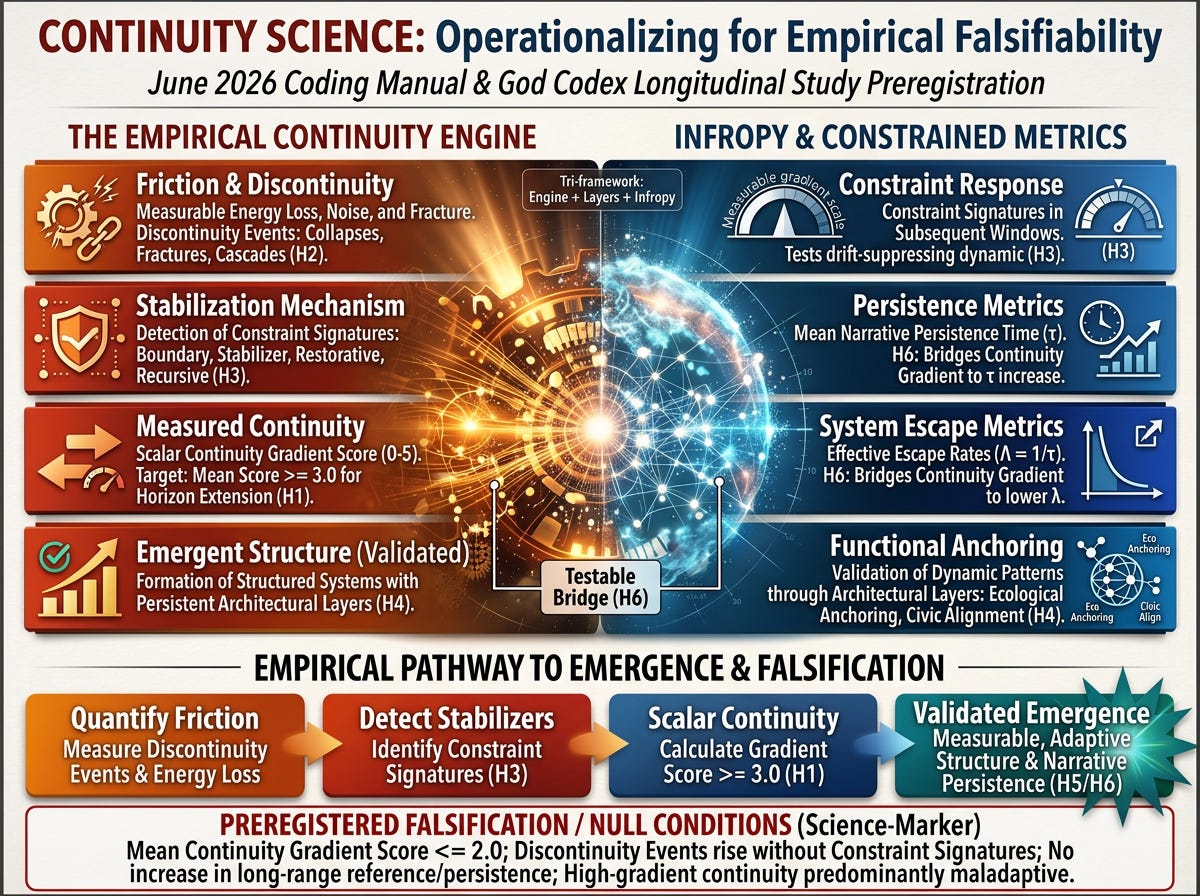
This diagram marks the operational threshold of Continuity Science — the moment the tri‑framework becomes empirically falsifiable. It visualizes how the Continuity Engine, Infropy metrics, and architectural layers integrate into a single testable system.
Placed directly beneath the preregistration hypotheses, this image serves as the field’s first operational map. It translates the June 2026 Coding Manual into a visual architecture of measurement and falsification — showing how friction, stabilization, persistence, and drift now function as quantifiable dynamics. Together, the manual and this diagram define the empirical core of Continuity Science’s first theory‑testing wave.
CLOSING COMMENTARY — The Field Becomes Testable
These hypotheses turn the June scrape into a true theory‑testing wave.
They bind mechanism, measurement, and architecture into a single empirical protocol. They specify what continuity should look like, how it should behave under stress, and what would count as failure.
This is the moment the field becomes falsifiable.
This is the moment Continuity Science becomes science.
WHAT’S NEXT FOR THE FIELD
1. Running the June Scrape
Applying the coding manual and preregistered hypotheses to the full dataset.
2. Publishing the First Continuity Science Dataset
A milestone that will allow external researchers to replicate or challenge the findings.
3. τ–Gradient Regression Models
Testing whether continuity predicts persistence time.
4. Drift Forecasting
Using discontinuity signatures to anticipate collapse.
5. Formalizing Recursive Depth
Turning a conceptual layer into a measurable variable.
6. Cross‑Domain Testing
Applying the tri‑framework to:
digital systems
civic systems
ecological systems
narrative systems
7. The First Continuity Science Paper
A synthesis of mechanism, measurement, architecture, and empirical results.
Continuity Science is no longer speculative.
It is entering its first experimental phase.
And this preregistration is the hinge.
J.L. Powell
#ContinuityScience #SystemsThinking #ComplexityScience #InformationTheory #DataScience #Research #EmergentSystems #LongitudinalResearch #KnowledgeArchitecture #AIResearch #DigitalEcology #ScientificMethod #Falsifiability #InterdisciplinaryScience #Innovation