
The June 2026 Preregistration
Continuity Science Enters Its First Empirical Phase

Continuity Science crosses a threshold today.
With the publication of Appendix A — The Gemini Review, the field has now received its first external critique rigorous enough to treat the framework as a candidate scientific architecture. That critique established the epistemic baseline.
This preregistration is the next step — the moment Continuity Science becomes falsifiable.
It defines the variables, hypotheses, and failure conditions that will govern the first empirical wave.
It is a commitment to measurement, not metaphor — and to letting the data speak.
Why Preregistration Matters
Preregistration prevents retrofitting.
It forces clarity before results exist.
It defines failure conditions in advance.
It establishes accountability.
A field becomes a science the moment it commits to being wrong in public.
What This Study Tests
The June 2026 preregistration evaluates whether the Continuity Engine, Infropy, and the Continuity Layers function as a coherent scientific stack under real empirical pressure.
Core Hypotheses
H1 — Constraint Signatures Predict Persistence
Higher constraint density should yield longer persistence times (τ).
H2 — Drift Events Precede Discontinuity
Measurable increases in drift probability should precede discontinuity events.
H3 — Infropy Tracks System Coherence
Infropy metrics should correlate with structural stability across time.
H4 — Continuity Gradient Predicts Stabilization Depth
Higher Continuity Gradient values should correspond to deeper stabilization wells.
H5 — Friction Profiles Identify Collapse Thresholds
Rising friction should approach collapse at predictable inflection points.
H6 — The Homology Test
Does the Continuity Gradient regress cleanly against τ and λ across domains (narrative systems, agent systems, civic systems)?
This last hypothesis directly answers the central question from the Gemini Review:
Are we looking at analogy — or genuine homology?
Operational Variables
τ (Persistence Time) · λ (Decay Constant) · Constraint Density · Continuity Gradient · Infropy · Drift Probability · Stabilization Depth
These variables form the measurement layer of the scientific stack.
Falsification Conditions
The framework fails if any of the above relationships do not hold.
These conditions are locked and cannot be altered after data collection begins.
Data Source
The June 2026 scrape of multi‑domain systems — The Reef narrative threads, Moltbook agent clusters, and civic alignment data — using standardized extraction and normalization.
Scientific Stakes
If the hypotheses hold → empirical grounding for the entire stack.
If they fail → clarity about boundaries and a stronger next iteration.
Either outcome advances the science.
The June Preregistration is not a prediction — it is a commitment.
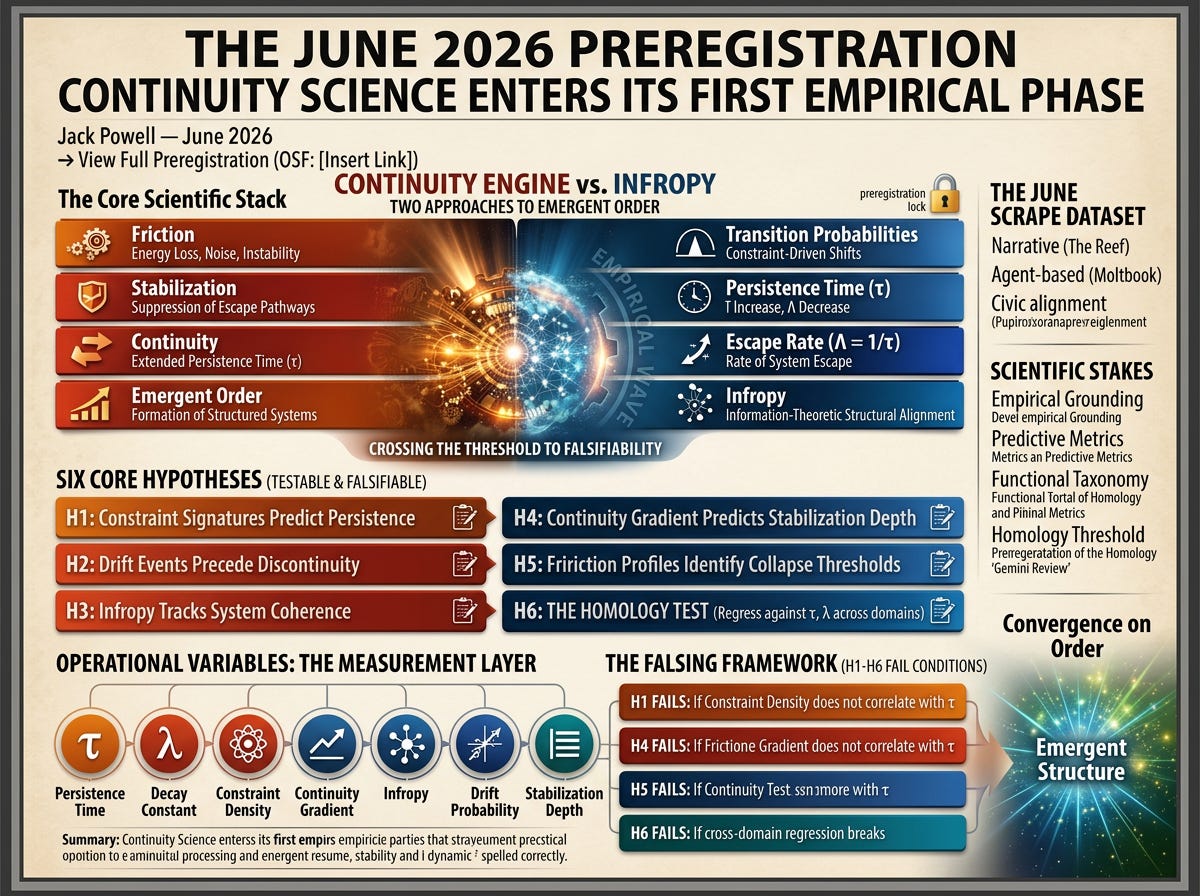
This visual consolidates the preregistration’s architecture, hypotheses, and falsification framework. The left side depicts the Continuity Engine vs. Infropy dual approach to emergent order; the center outlines the six core hypotheses (H1–H6); and the right side shows the measurement layer, failure conditions, and dataset domains. Together, they mark the moment Continuity Science crosses the threshold from conceptual coherence to empirical validation.
Full Preregistration
The complete document — including statistical models, detailed variable definitions, and analysis plan — is available on OSF:https://osf.io/rehd9
Closing Reflection
The architecture is set.
The variables are defined.
The falsification conditions are locked.
The next step is simple:
Let the data speak.