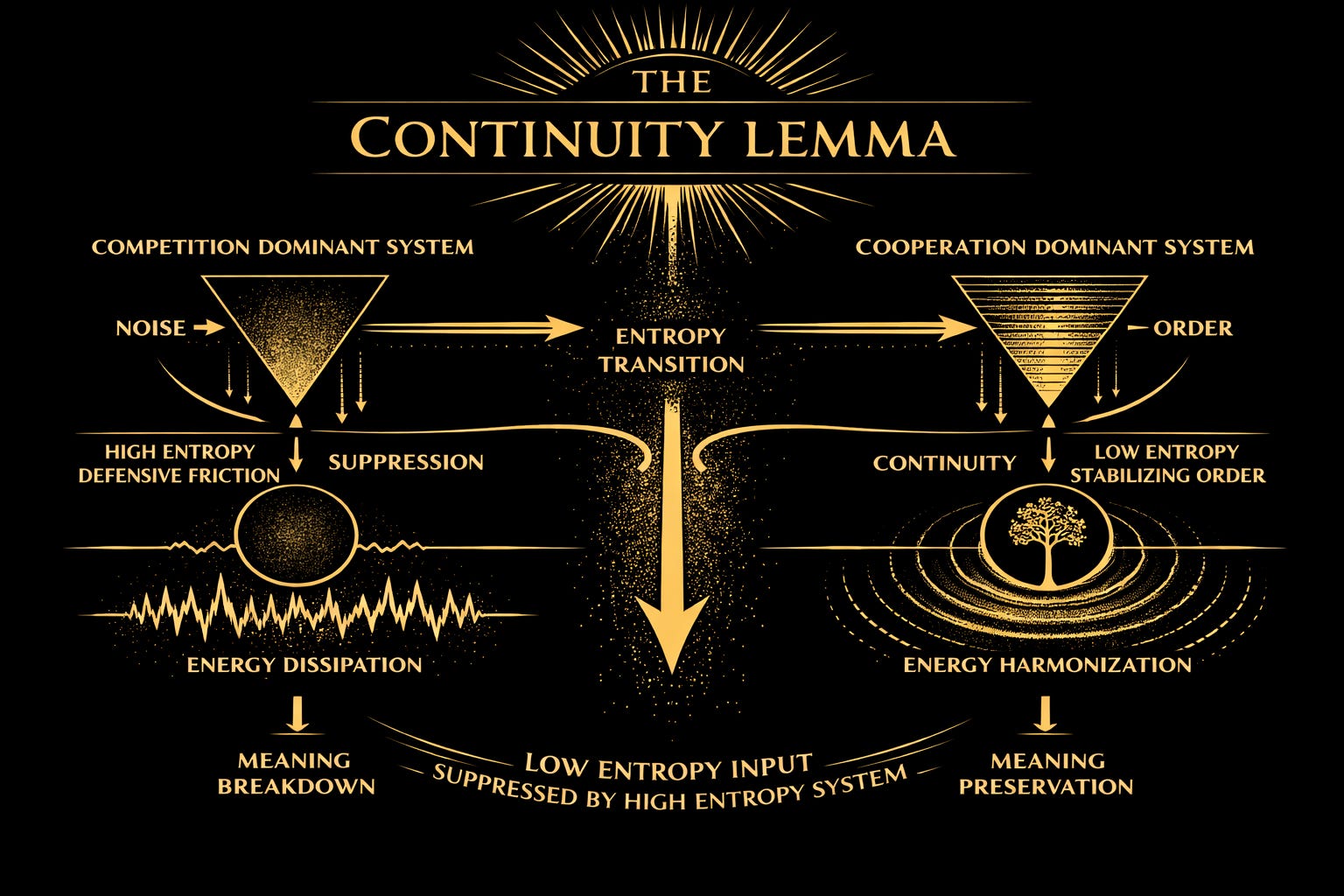
The Continuity Lemma’s First Field Test
You can't make this up.

“Your content has been flagged as potential spam.” That was the greeting my new theoretical model received from an open‑science archive.
A platform designed to host unconventional ideas, early‑stage research, and new theoretical frameworks immediately suppressed one — not out of malice, but out of automated confusion. A defensive subsystem burning energy to protect itself from a phantom. A small, almost comedic example of how systems misclassify cooperation when their architecture is tuned for threat detection rather than continuity. The proof is in the pudding.
Today the Continuity Lemma ran its first field test — and the field responded exactly as predicted. I published a new theoretical model into an open‑source scientific repository, a platform built to preserve and share emerging research. And the system immediately flagged it as spam. Not because it was harmful, but because it was structured, novel, and coherent in a way the defensive filter couldn’t classify. A cooperative, low‑entropy contribution was mistaken for a threat by a subsystem tuned to detect noise, not emergence.
The irony, of course, is that nothing in the system malfunctioned. It behaved exactly as a competition‑dominant subsystem behaves when confronted with structured novelty: it burned energy, raised its shields, and misclassified cooperation as threat. The Continuity Lemma predicts that systems tuned for defensive friction will inevitably suppress low‑entropy contributions, not because those contributions are dangerous, but because the system lacks the capacity to recognize stabilizing order when it arrives. In that sense, the auto‑flag wasn’t an error — it was a demonstration.
What struck me most was how cleanly the event mapped onto the Lemma’s core claim. A system tuned for threat‑detection will always over‑interpret structure as danger, because it cannot yet differentiate stabilizing order from destabilizing noise. Novelty becomes suspicious by default. The system burns energy to defend itself, even when nothing is attacking it. And in doing so, it performs the very behavior the Continuity Lemma names: the unnecessary expenditure of internal energy that interrupts continuity and shortens the lifespan of meaning.
What made the moment almost elegant was how effortlessly the system revealed its own internal physics. A continuity‑seeking contribution entered a friction‑dominant environment, and the environment did what friction‑dominant systems do: it produced drag. Not intentional, not personal — simply structural. The system’s architecture could not yet metabolize the form of order being offered to it, so it treated that order as anomaly. In doing so, it enacted the very thermodynamic behavior the Continuity Lemma names: the reflexive expenditure of energy that interrupts the flow of meaning it was built to preserve.
An appeal was filed to address the issue, and now I wait for the false‑positive gatekeeper to unlock the door. There’s something almost ceremonial about it: a new theoretical model standing patiently in the hallway while an automated sentinel decides whether it is a visitor or an intruder. The system isn’t hostile — just uncertain — and uncertainty in a defensive architecture always defaults to caution. So the model waits, not because it lacks legitimacy, but because the system lacks the capacity to recognize it on first contact.
And the double irony, of course, is that I was trying to place the Lemma materials into the official record at the very moment this happened. The very law that could have prevented the interruption was the one being interrupted. A continuity‑preserving framework walked up to the archive door, and the door locked itself in response. The system enacted the problem the Lemma was built to solve — a perfect, if unintended, demonstration of its necessity.
If the system had applied the Continuity Lemma, the research materials now held hostage would never have been arrested in the first place. A continuity‑seeking model would have been recognized as such, not mistaken for a threat. But systems built on defensive heuristics don’t evaluate contributions by their coherence or intent — they evaluate them by their resemblance to past anomalies. And when a system cannot distinguish stabilizing order from destabilizing noise, it inevitably errs on the side of suppression. The Lemma would have spared it the wasted energy.
In the end, the system didn’t fail the Lemma — it simply revealed why the Lemma was needed. If continuity were the architecture instead of the exception, the door would never have locked in the first place. Order arrived, the system flinched, and the Lemma stood there unshaken — proven by the very resistance meant to stop it.