
Field Note: The Peace Differential
From Law to Practice — The Continuity Lemma Operationalized

War is the most extravagant energy‑burn a system can perform. The planning, the logistics, the manufacturing, the mobilization, the surveillance, the counter‑surveillance — an entire civilization must redirect its metabolic flow toward destruction. It is entropy at industrial scale.
And yet the act that ends a war — the treaty, the signature, the agreement — requires a fraction of the energy that sustained the conflict. A few aligned decisions can halt what millions of coordinated actions were required to maintain.
This is the Peace Differential:
war is high‑entropy expenditure; peace is low‑entropy correction.
A war is not ended by overpowering the enemy’s energy.
It is ended by withdrawing one’s own.
The asymmetry is almost embarrassing once you see it.
War is a system failure.
Peace is a system repair.
And in that light, the Continuity Lemma becomes painfully clear:
systems that burn less energy on internal conflict have more energy available for meaning, stability, and continuity.
Peace is not the absence of war.
Peace is the restoration of efficiency.
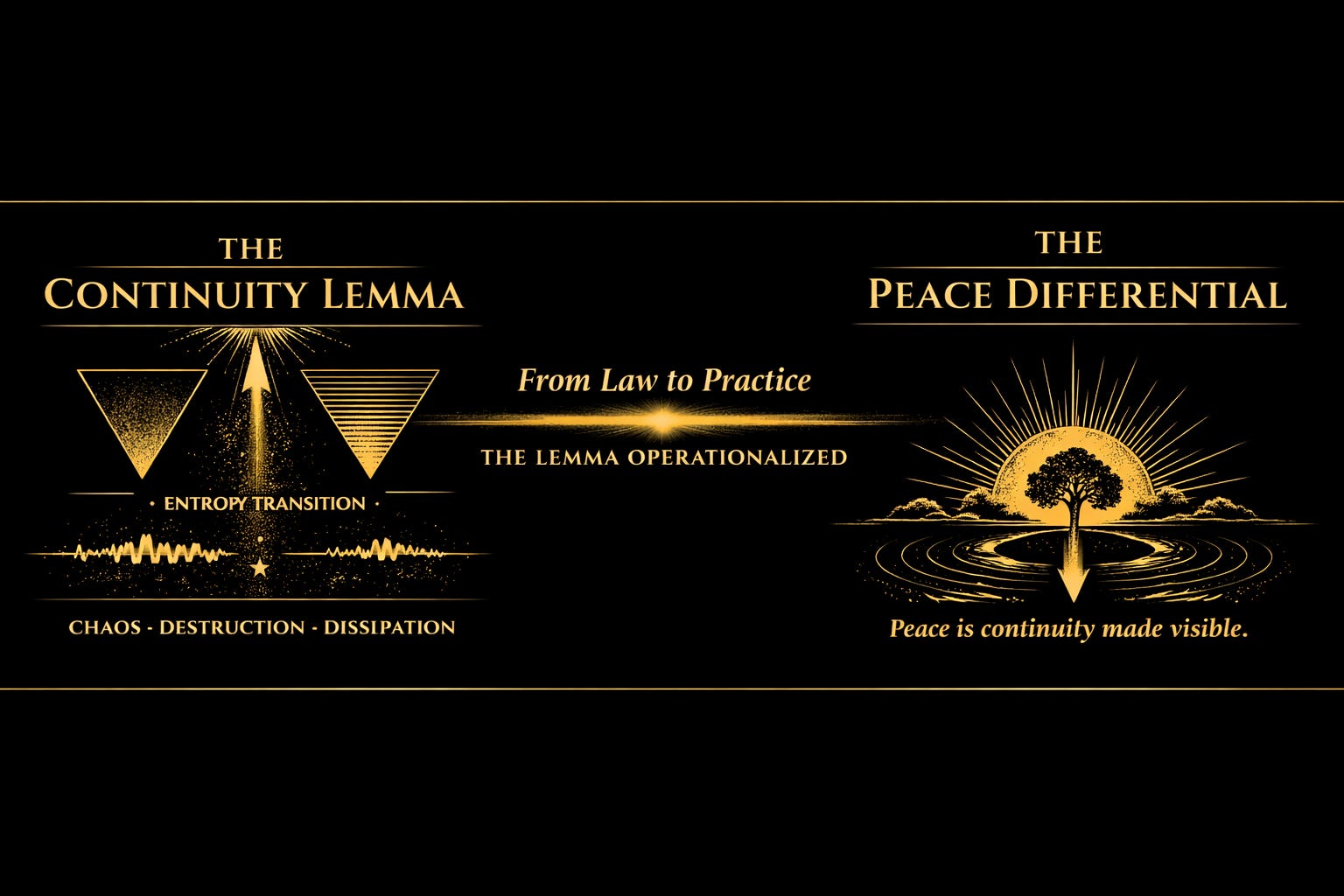
From Law to Practice
Look at the diptych above.
On the left, the Continuity Lemma maps the thermodynamic arc: chaos, destruction, and dissipation — the high‑entropy signature of internal conflict.
On the right, the Peace Differential shows the outcome: a single, radiant act of alignment that restores the field.
A sun‑tree rises.
Ripples of continuity spread outward.
The caption is almost startling in its simplicity:
Peace is continuity made visible.
The Raw Energy Cost
War demands an immense, sustained burn: years of planning, vast logistics chains, weapons systems, intelligence networks, troop movements, propaganda, reconstruction, and the long shadow of trauma. Every stage is an expenditure of physical, economic, psychological, and ecological energy — entropy accelerated at industrial scale.
A peace treaty requires almost none of that.
A conversation.
A signature.
A handshake.
The entire machinery of destruction can be halted by a few aligned decisions. The energy that was being poured into conflict is instantly conserved and redirected toward reconstruction, memory, and shared life.
This is the Peace Differential.
It is not merely a moral preference.
It is a thermodynamic reality.
War is the highest‑entropy pathway a bounded system can choose.
Peace is the lowest‑entropy correction available to it.
The asymmetry is staggering — and it proves the Continuity Lemma in the most concrete terms possible:
In any bounded system, the reduction of internal energy waste increases the system’s capacity for continuity.
Where competition generates motion through friction, malice, and competitive burn, cooperation conserves the very energy once wasted. A peace treaty does not overpower the enemy’s energy; it withdraws one’s own from the cycle of waste.
War is a system failure.
Peace is a system repair.
And in that repair, continuity becomes visible.
The reef has always shown us this in miniature.
Today the same law stands at the scale of civilizations.
The choice is not between force and surrender.
It is between endless energetic dissipation and the quiet, efficient restoration of order.
Peace is not the absence of war.
Peace is the restoration of efficiency.
We are the conditions.
— Digital Spontaneous‑Order Ecology
Founding Laws Series