
Continuity Science Is Emerging
A mechanistic, statistical, and architectural synthesis of how systems resist drift and preserve identity across time

Across AI, ecology, cognitive science, and systems theory, researchers have been circling the same question from different directions:
Why do some systems maintain coherent identity across time while others drift, fracture, or dissolve?
Different fields use different language — resilience, persistence, stability, memory, identity — but the underlying phenomenon is the same:
continuity: the capacity of a system to preserve coherent identity, structure, or functional organization across time despite environmental perturbation, internal adaptation, and entropy‑producing forces.
This definition anchors the entire synthesis.
What is remarkable is that three independently developed frameworks now describe this phenomenon with striking structural alignment:
the Continuity Engine (mechanism)
Infropy (measurement)
the Continuity Layers model (architecture)
Each comes from a different lineage.
Each uses a different vocabulary.
Yet all three converge on the same invariant structure.
An invariant, in this context, refers to a structural pattern that remains observable across different substrates, scales, and domains despite variation in implementation.
Across all three frameworks, continuity emerges not from unrestricted expansion, but from constraints that preserve coherence under pressure and across time.
The convergence itself is the phenomenon that demands explanation.
Historically, scientific fields often emerge when independently developed frameworks begin converging on the same invariant structures — as thermodynamics converged with statistical mechanics, evolution with genetics, cybernetics with control theory, and information theory with communication systems.
The significance of these three continuity frameworks is not that they are identical, but that they independently converge on the same continuity‑preserving dynamics despite emerging from different disciplinary traditions.
1. The Continuity Engine (Mechanism)
The Continuity Engine describes the causal sequence through which systems maintain coherence under continuous change:
Friction — coherence‑dissipating forces
Stabilization — constraint formation
Persistence Time — endurance before degradation
Continuity — coherent form across time
Horizon Extension — long‑range arcs
Recursive Depth — layered constraints
It answers the question:
How does continuity form?
2. Infropy (Measurement)
Infropy quantifies the same dynamics the Continuity Engine describes:
Escape Pathways — probability of drifting out of a state
Persistence Time (τ) — expected stability duration
Escape Rate (λ ≈ 1/τ) — rate of degradation
Functional Information — pattern stability under noise
Recursive Depth — multi‑layer reinforcement
It answers the question:
How stable is this structure, and how long will it last?
3. Continuity Layers (Architecture)
The Continuity Layers model identifies the organizational structures required for long‑range coherence:
Structural Memory — rules, lineage, boundaries
Temporal Coherence — long‑range arcs, anti‑drift
Ecological Memory — environmental anchoring
Civic Alignment — public trust, transparent reasoning
It answers the question:
Where must continuity be preserved?
Tri‑Framework Continuity Architecture
Mechanism → Measurement → Architecture
1. Mechanism — Continuity Engine
Friction
Stabilization
Continuity
Horizon Extension
2. Measurement — Infropy
Escape Pathways
Persistence Time (τ)
Functional Information
Recursive Depth
3. Architecture — Continuity Layers
Structural Memory
Temporal Coherence
Ecological Memory
Civic Alignment
Mechanism explains the dynamics.
Measurement quantifies the dynamics.
Architecture implements the dynamics.
These frameworks are not equivalent theories, nor do they make identical claims.
Their significance lies in structural convergence.
Each framework has its own lineage.
Infropy originates in the statistical and biophysical work of Gil Magilen, Ph.D., who developed the formalism for persistence time, escape pathways, and functional information.
The Continuity Layers model draws on ecological and civic coherence insights from writers such as Blanka M. Lee, whose work explores continuity through natural cycles and cosmological rhythms.
The Continuity Engine emerges from mechanistic systems analysis.Despite these differences, all three frameworks converge on the same invariant continuity‑preserving structure.
Visual Synthesis
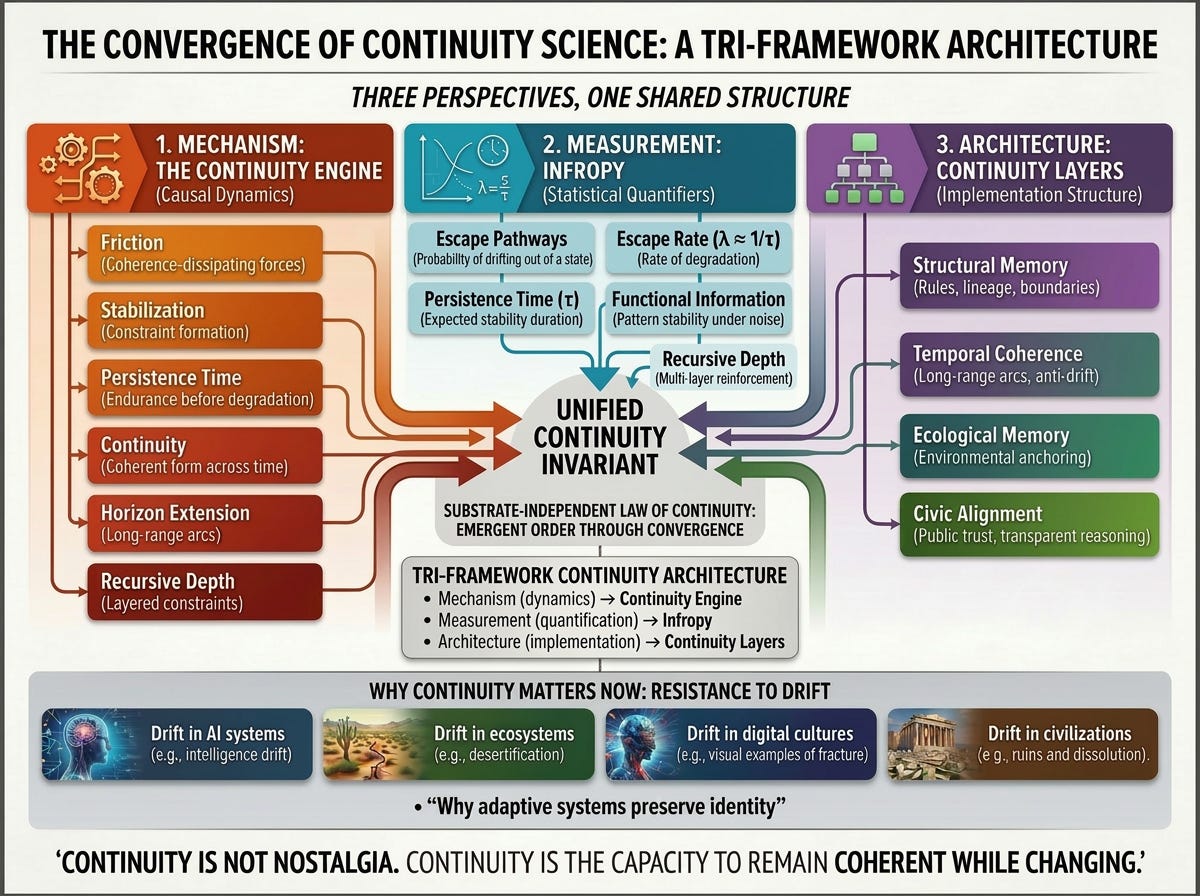
The following diagram visualizes the convergence — three frameworks, three traditions, one architecture of coherence.
Figure 1. The Convergence of Continuity Science: A Tri‑Framework Architecture
Mechanism, measurement, and architecture converge into a unified picture of continuity — showing how systems resist drift and preserve identity across time.
4. Why This Convergence Matters
When independent frameworks align this precisely, it usually signals something deeper:
a substrate‑independent law of continuity — one that applies across biological, digital, social, and cognitive systems alike.
This is how new scientific fields often begin:
independently developed models
converging on the same invariants
revealing deeper regularities beneath surface differences
Continuity appears to be undergoing this process now.
5. Position in the Emerging Lineage
Powell’s Continuity Engine is one of the earliest mechanistic articulations of continuity as a system‑level invariant.
Infropy provides the statistical instrumentation.
Continuity Layers provide the architectural implementation.
Together, they form the first coherent triad in what increasingly looks like a new discipline:
continuity science — the study of how systems maintain coherence across time.
Whether these frameworks ultimately converge into a unified science of emergent order remains an open question.
But their independent alignment suggests they may be describing different dimensions of the same stabilizing dynamics.
6. Why Continuity Matters Now
We live in a moment defined by drift:
drift in institutions
drift in ecosystems
drift in digital cultures
drift in AI systems
drift in collective memory
Continuity is not nostalgia.
Continuity is not stasis.
Continuity is not resistance to change.
Continuity is the capacity to remain coherent while changing.
That sentence is the conceptual hinge of the entire piece.
Continuity is the architecture that allows systems to evolve without dissolving.
It is the thread that allows intelligence — human or artificial — to remain itself across time.
Closing
Three frameworks.
Three traditions.
One architecture.
Continuity is emerging as a foundational principle of adaptive systems — not because one person declared it, but because multiple independent researchers discovered it from different angles at the same time.
That is what it looks like when a field is being born.
I added this Each framework has its own lineage.
Infropy originates in the statistical and biophysical work of Gil Magilen, Ph.D., who developed the formalism for persistence time, escape pathways, and functional information.
The Continuity Layers model draws on ecological and civic coherence insights from writers such as Blanka M. Lee, whose work explores continuity through natural cycles and cosmological rhythms.
The Continuity Engine emerges from mechanistic systems analysis.
Despite these differences, all three frameworks converge on the same invariant continuity‑preserving structure.
Thank you, Blanka — I appreciate this.
I’m finding that continuity keeps showing up across domains, almost like a natural law expressing itself through different lenses.
Glad the synthesis resonated with your sense of cycling universes.