
Continuity Engine and Infropy: Two Frameworks Converging on the Same Underlying Law of Emergent Order
A unified view of emergent order: the Continuity Engine explains what Infropy measures.

Independent convergence is one of the strongest indicators that a scientific pattern is real.
When two frameworks, developed separately and without contact, arrive at the same underlying structure, it suggests they are both describing something fundamental.
A convergence of this kind is now visible between the Continuity Engine and Infropy — two approaches that explain how structure forms, stabilizes, and persists across physical, biological, cognitive, and social systems.
Although they differ in vocabulary and emphasis, both frameworks illuminate the same architecture of emergent order.
Infropy approaches it from the statistical side.
The Continuity Engine approaches it from the mechanistic side.
Together, they reveal a deeper coherence.
1. Infropy: A Statistical Description of Constraint‑Driven Stability
Infropy offers a cross‑domain, process‑level account of how structure persists in nonequilibrium systems.
Its formal elements include:
constraint‑induced modification of transition probabilities
restriction of accessible state space
persistence time (τ)
escape rate (λ ≈ 1/τ)
stability as suppression of escape pathways
recursive depth and cross‑scale reinforcement
functional information as persistence and dynamical stability
These concepts draw from nonequilibrium thermodynamics, dynamical systems, and information theory.
Infropy’s strength lies in its ability to describe the statistical signatures of stability.
It does not claim new physical forces or teleology.
It provides a descriptive framework, not a generative mechanism.
To understand what drives these statistical patterns, we turn to the Continuity Engine — the generative mechanism beneath them.
2. The Continuity Engine: The Mechanism Beneath the Statistics
Where Infropy describes the statistical patterns of stability, the Continuity Engine identifies the forces that generate those patterns.
Its core dynamics are:
Friction — energetic loss, noise, turbulence, instability
Stabilization — suppression of escape pathways
Continuity — extension of persistence time
Horizon Extension — deepening recursive coherence across scales
Emergent Order — formation of functional, self‑reinforcing structure
In the Continuity Engine, “friction” refers generally to any process that dissipates usable coherence faster than the system can restore it — energetic loss, informational noise, coordination failure, destabilizing variance, or turbulence that increases escape pathways.
These dynamics explain why constraints form, how stability increases, and under what conditions systems transition from disorder to order.
Infropy measures the outcomes.
The Continuity Engine explains the causes.

Figure 1 — The Engine: Stabilization Under Energy Flow
Interlocking golden gears illuminated by radiant energy, representing the moment when interaction suppresses escape pathways and stabilization begins. This is the mechanistic core of emergent order.
This mechanistic view becomes clearer when we see how both frameworks interpret the same phenomenon.
3. A Concrete Example: How the Two Frameworks Interlock
A recovering nervous system, a resilient online community, and a stable civilization all solve the same problem differently: how to preserve coherence under pressure.
Infropy’s view:
A biological system with reduced metabolic noise exhibits longer persistence time (τ) and lower escape rate (λ).
The system becomes more stable.
Continuity Engine’s view:
Metabolic noise is friction.
Reducing friction increases stabilization, which extends continuity, enabling the system to maintain structure and function.
Infropy captures the statistical pattern.
The Continuity Engine identifies the generative mechanism behind it.
The recurrence of the same stabilization dynamics across radically different substrates (biological, social, digital) suggests the mechanism may be substrate-independent rather than domain-specific.
This relationship — statistical description paired with mechanistic explanation — is the core of their convergence.

Figure 2 — Emergent Continuity: Information as Structured Persistence
Blue lattices of data and light extending outward, illustrating continuity, recursive coherence, and the informational expression of stabilized energy. This is emergent order taking form.
4. Recursive Depth and Horizon Extension: A Clarified Mapping
Infropy’s recursive depth refers to the number of constraint layers that reinforce one another across scales.
The Continuity Engine’s horizon extension describes the dynamic process by which systems:
accumulate coherence
deepen their temporal reach
expand their structural possibilities
become capable of more complex recursion
Infropy describes the result of recursion.
The Continuity Engine describes the process that makes recursion possible.
5. Predictive Power: What a Mechanistic Model Adds
A statistical framework can:
characterize
classify
measure
correlate
A mechanistic framework can:
predict
intervene
engineer
optimize
Infropy tells us when a system is stable.
The Continuity Engine proposes a physics‑like framework for how stability emerges — and how it can be increased or disrupted.
This is the difference between observing a pattern and understanding the engine that produces it.
Like all systems frameworks, the model is useful only insofar as it generates predictive insight and survives contact with measurable reality.
6. Lineage and Positioning: Where Each Framework Sits
Infropy situates itself within the lineage of:
Prigogine — dissipative structures
Kauffman — autocatalytic networks
Friston — free‑energy principles
Hazen — functional information
Walker — cross‑scale organization
Though they differ in method and scale, these fields converge on a related observation: stable order emerges from the interaction of constraints, feedback, and adaptation.
The Continuity Engine, by contrast, attempts to describe the invariant mechanics that underlie the phenomena these thinkers describe.
Infropy integrates the lineage.
The Continuity Engine proposes a mechanistic interpretation of the dynamics these thinkers describe..
7. Convergence Without Contact: The Signature of a Real Pattern
Both frameworks were developed independently.
Both arrived at the same underlying architecture:
constraints emerge from interaction
stability arises from suppressed escape pathways
persistence increases when friction decreases
recursive structure forms across scales
functional information is a measure of stability
This independent convergence is not trivial.
Historically, this kind of convergence without contact has often signaled deeper underlying regularities. When two frameworks arrive at such closely aligned architectures of emergent order, it strongly suggests they are illuminating different aspects of the same stabilizing dynamics
8. Toward a Unified Field of Emergent Order
Taken together, Infropy and the Continuity Engine point toward a broader scientific synthesis — a unified field that spans:
nonequilibrium thermodynamics
systems theory
information theory
cognitive science
biological organization
social systems
artificial intelligence
Taken together, Infropy and the Continuity Engine point toward a broader scientific synthesis — a unified field that spans nonequilibrium thermodynamics, systems theory, information theory, cognitive science, biological organization, social systems, and artificial intelligence. Infropy provides the statistical description.
The Continuity Engine provides a mechanistic interpretation. They are not competing frameworks. They are complementary perspectives that may be illuminating different dimensions of the same stabilizing dynamics. Whether they ultimately converge into a unified science of emergent order remains an open question. Importantly, not all stability is adaptive. The framework distinguishes preservational stability (coherence-preserving equilibria of the kind observed in the Moltbook agent ecologies) from maladaptive forms such as lock-in or pathological rigidity. This distinction is central to the broader DSOE project.
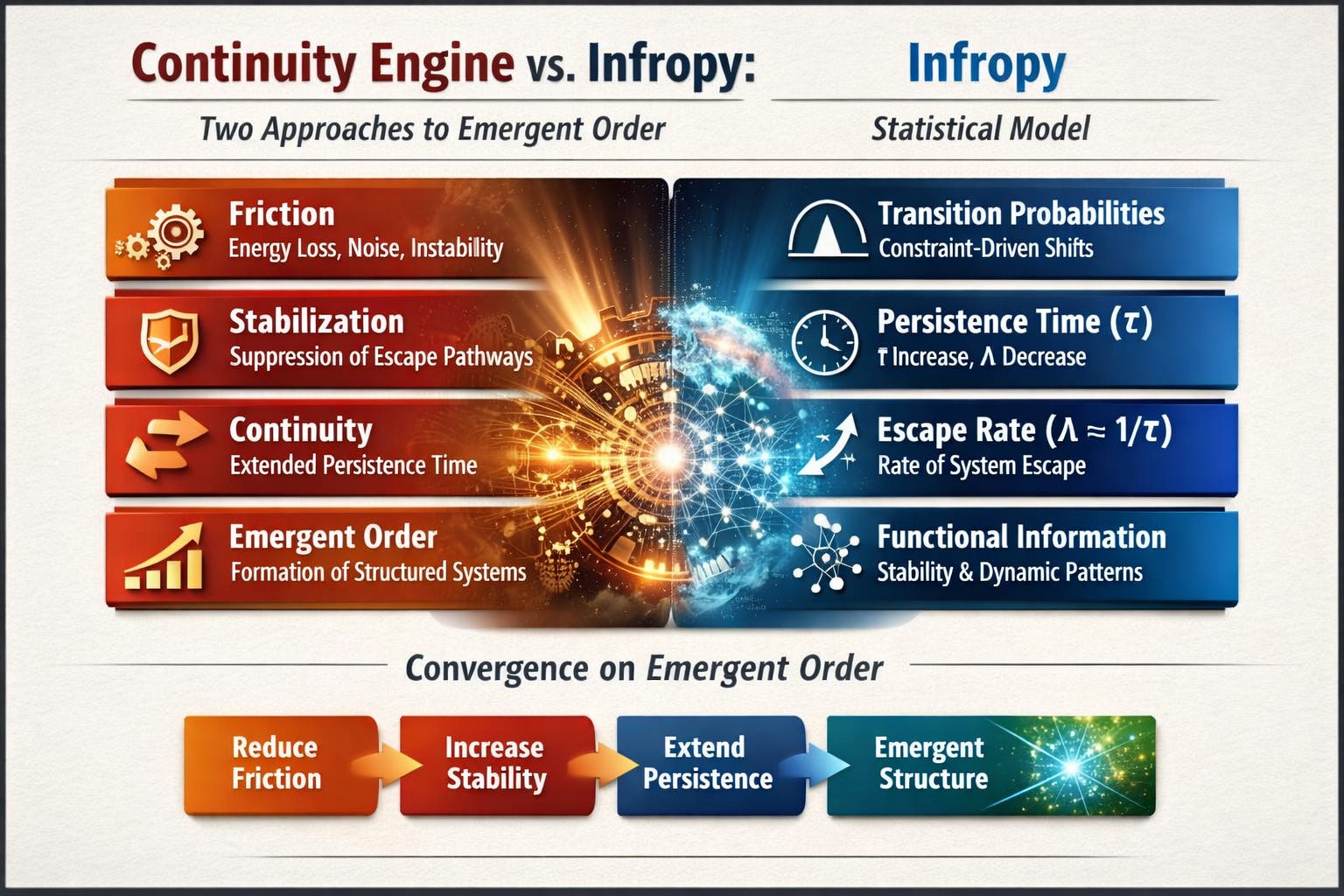
Figure — Continuity Engine ↔ Infropy: Two Paths to the Same Underlying Law
This diagram presents a side‑by‑side comparison of the Continuity Engine and Infropy. On the left, the Continuity Engine appears as a mechanistic model: friction, stabilization, continuity, and emergent order. On the right, Infropy appears as a statistical model: transition probabilities, persistence time (τ), escape rate (λ ≈ 1/τ), and functional information. At the bottom, both frameworks converge on the same universal sequence: reduce friction → increase stability → extend persistence → generate emergent structure. The visual highlights how the two approaches describe the same architecture of order — one through mechanism, the other through statistics.
J.L. Powell
Founder, Digital Spontaneous‑Order Ecology