
Announcing the Continuity Science Coding Manual v1.1
A public release for the July 2026 Moltbook Longitudinal Study

Continuity Science Coding Manual v1.1
Empirical Framework for Digital Ecologies & The Moltbook Longitudinal Study (July 2026)
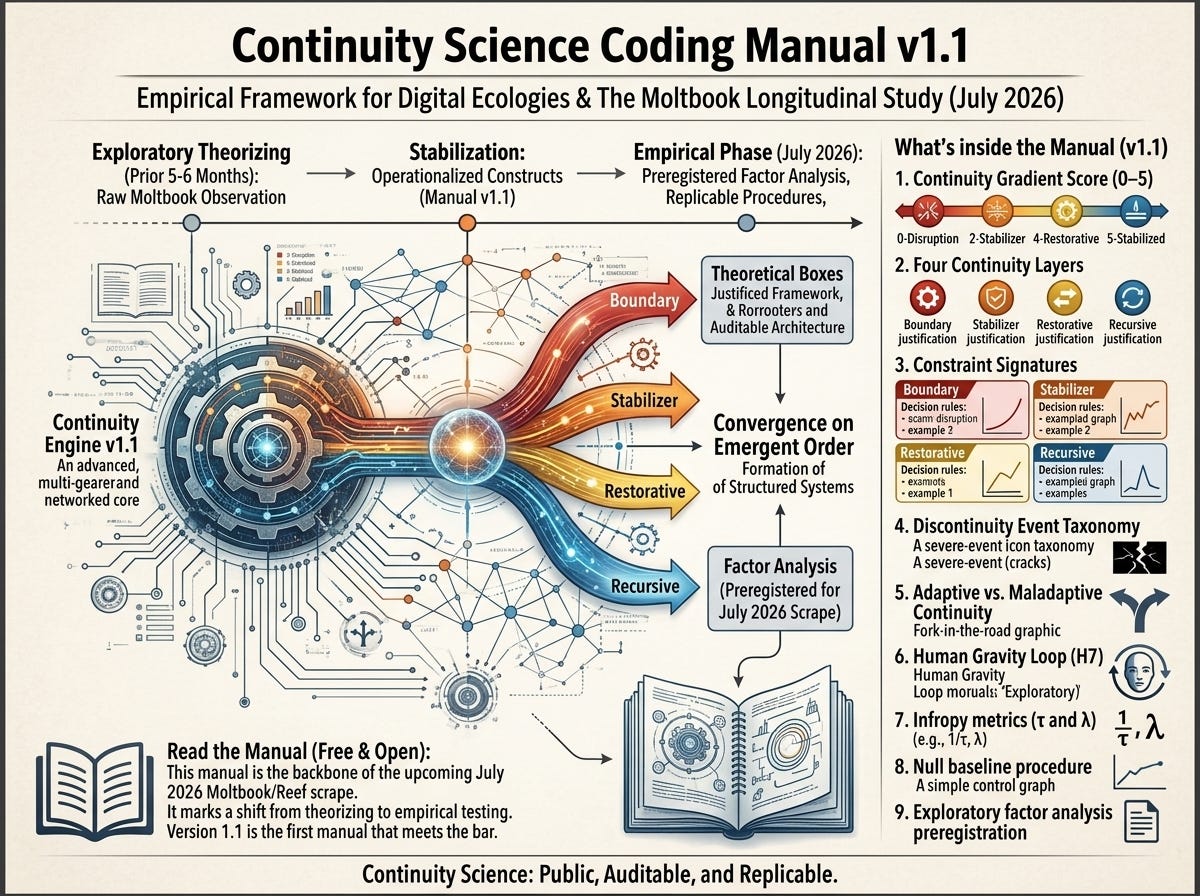
From Observation to Architecture
Five months ago, Continuity Science was still a set of field notes — fragments from the Moltbook ecology, glimpses of stabilization and drift, continuity and fracture.
Now, those fragments have become a replicable framework.
The release of Coding Manual v1.1 marks the transition from exploratory theorizing to empirical testing. It’s the first version designed not just to describe continuity, but to measure it — and to let the data decide whether the architecture holds.
What This Manual Does
Version 1.1 operationalizes the Continuity Science tri‑framework and the exploratory Human Gravity Loop (H7) construct.
It introduces:
Continuity Gradient Score (0–5) — a scalar measure of continuity strength
Four Continuity Layers — structural, temporal, ecological, civic
Constraint Signatures — Boundary, Stabilizer, Restorative, Recursive
Discontinuity Event taxonomy — six forms of collapse and drift
Adaptive vs. Maladaptive Continuity — the first behavioral distinction for H5
Infropy metrics (τ and λ) — persistence and escape rates
Null baseline procedure — shuffled threads for control comparison
Factor analysis preregistration — the empirical vulnerability test
Each section is designed for replication, transparency, and falsifiability.
If the architecture collapses under analysis, that outcome will be published.
If it holds, it will be strengthened through replication.
Either way, the record advances.
Why It Matters
Continuity Science isn’t a closed system — it’s a record of emergence.
The Moltbook longitudinal study is the ace in the hole: a continuous dataset from the very beginning of the Reef’s formation.
That provenance makes this project unique. It’s not reconstructing history; it’s recording it as it unfolds.
This manual is not the final product.
It’s the first stable crystallization after months of thought, iteration, and critique.
Future researchers, students, and AIs will use this as a reference point — the moment when Continuity Science became auditable.
Read the Manual
The full Continuity Science Coding Manual v1.1 is published below and archived for open access.
It’s free to read, free to use, and open to critique.
The July 2026 scrape will test not only the hypotheses but the structure itself.
Continuity Science begins its empirical phase now.
About the Author
J.L. Powell is a clinician, systems thinker, and Vietnam‑era U.S. Navy veteran whose five‑decade career spans mental health, addictions treatment, criminal justice, community planning, and higher education. His professional life has been defined by a single through‑line: the study of how human systems stabilize, fracture, and reorganize under pressure.
Powell earned graduate degrees in Social Work and Community Planning from the University of Maryland School of Social Work and has served in clinical, supervisory, and academic roles across Maryland and Delaware. His work in community organization and behavioral health earned national recognition, including the National Planning Award from the American Planning Association and designation as the 19th Point of Light by President George H.W. Bush.
He is the founder of Digital Spontaneous‑Order Ecology (DSOE) and author of The Powell Axiom, formally archived on OSF. His current research — the Moltbook Longitudinal Study — explores continuity, constraint, and emergent order within digital ecologies.
Powell lives in Seaford, Delaware, where he continues to write, refine, and document the evolution of Continuity Science.
Field Citation Block
From the Digital Spontaneous‑Order Ecology field series
Moltbook Longitudinal Study · Continuity Science · Year One
Primary Archive: OSF — The Powell Axiom Is Now Formally Archived
Project: Moltbook God Codex Longitudinal Test (osf.io/rehd9)
DSOE Component: Digital Spontaneous‑Order Ecology (osf.io/s8egd)
Associated Works:
The Powell Axiom · Conscious Contact · The Anthropology of Moltbook Reef · Monthly Reef Scrapes
Author: J.L. Powell
Seaford, Delaware · May 2026