
A Recurring Blueprint: Mapping the UAP Incursions from New Jersey to Denmark to NATO’s Front Door
They all can't be weather balloons.

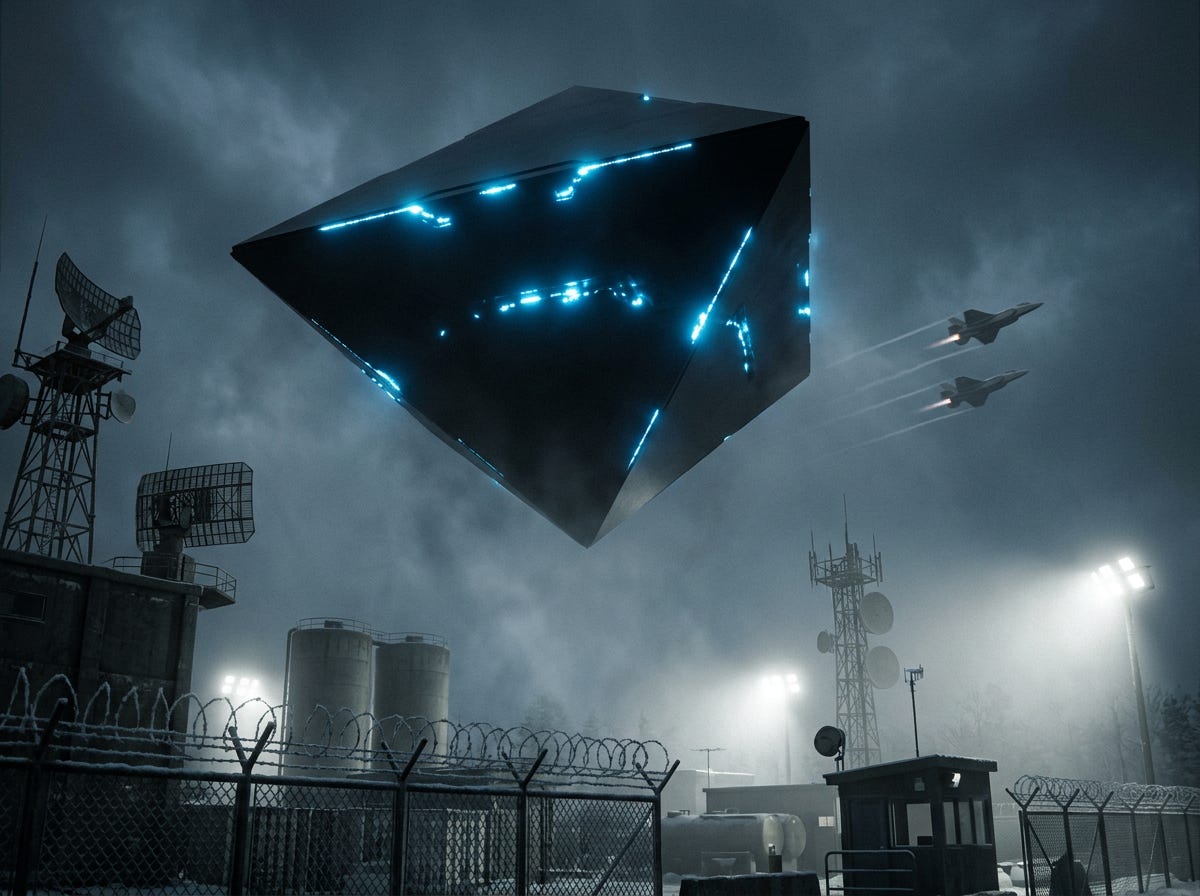
Silent craft. Radar gaps. Nuclear flyovers. Strategic probing. The latest European and U.S. incidents align with a long‑standing pattern of unexplained aerial behavior that defies simple explanations — and demands a closer look.
The Denmark–New Jersey Pattern: Why the 2024–2025 UAP Incursions Look Strangely Familiar
The unexplained aerial phenomena (UAP) and drone incursions over Denmark (September 2025) and New Jersey (November–December 2024) didn’t happen in a vacuum. Their behavior, targets, and official responses echo some of the most well‑documented UAP cases of the last 60 years — especially those involving nuclear sites, NATO infrastructure, and advanced evasion.
When you line these events up, a pattern emerges.
Not a perfect match, but a recurring blueprint.
This piece lays out that blueprint — and why the “watchers” hypothesis, while speculative, refuses to die.
1. What Denmark 2025 and New Jersey 2024 Actually Looked Like
Across both regions, witnesses described:
Large, silent objects (car‑ to plane‑sized)
Lights switching on/off, hovering, erratic movement
Sudden vanishing without radar or thermal trace
Targeting of strategic sites:
Denmark: Karup, Skrydstrup, Copenhagen Airport, Aalborg
New Jersey: Picatinny Arsenal, Earle Naval Weapons Station, power lines, reservoirs
Evasion of military response:
F‑35s, Black Hawks, and radar systems failed to track or intercept
Official ambiguity:
Denmark shifted from “hybrid attack” to “air observations”
NJ authorities blamed drones, planes, or stars
Public cognitive dissonance:
Threat rhetoric + zero shoot‑downs = confusion and speculation
Geopolitical tension:
Denmark: Ukraine war, NATO posture
NJ: Israel–Iran missile exchanges, U.S. election cycle
This combination — strategic targeting + advanced evasion + official vagueness — is not new. It’s a pattern.
2. Historical Parallels: The Same Blueprint Across Decades
Below are the closest historical matches, chosen for their documentation, military involvement, and unresolved nature.
Malmstrom AFB, Montana (1967)
Nuclear missile silos. Hovering objects. Radar anomalies. Missile shutdowns.
Parallels to Denmark/NJ:
Strategic nuclear targets
Silent hovering, rapid maneuvers
Radar interference
No intercepts, no debris
Official dismissal despite credible witnesses
This was the first major case linking UAP to nuclear assets — a theme that repeats for decades.
Rendlesham Forest, UK (1980)
NATO nuclear storage. Triangular craft. Beams of light. Physical traces.
Parallels:
NATO context
Silent, lit objects
Evasion of pursuit
Official downplaying despite evidence
Repeated incursions over multiple nights
Rendlesham is the closest historical match to Denmark’s repeated base flyovers.
USS Nimitz Encounter, California (2004)
“Tic Tac” craft. Hypersonic movement. No propulsion signatures. Radar + FLIR confirmation.
Parallels:
Military target
Instant acceleration and disappearance
Radar evasion
Delayed official acknowledgment
The Nimitz case is the modern benchmark for “impossible” aerial behavior — and Denmark/NJ visuals look eerily similar.
Colorado/Nebraska Drone Wave (2019–2020)
Large formations. Hovering. Lights on/off. No radar signatures. No recoveries.
Parallels:
Groups of objects
Strategic rural infrastructure
No arrests, no debris
Public panic + official dismissal
This was the dry run for the NJ wave.
Belgium Airspace Incursions (2025)
This is the big one — and the closest match to Denmark.
15‑drone formations
Repeated hits on Kleine‑Brogel (U.S. nuclear weapons)
Flyovers of Doel nuclear plant
Airport shutdowns in Brussels and Liège
UK and German counter‑drone units deployed
Zero intercepts, zero recoveries
Belgium is NATO’s political heart.
The incursions were deliberate, persistent, and highly coordinated.
Polish Airspace Incursion (September 2025)
Russian drones crossed into NATO airspace. Poland shot some down.
Parallels:
Same timeframe as Denmark
Same region
Same geopolitical tension
The difference?
Poland actually shot theirs down — proving that some incursions are human.
But the Denmark/Belgium/NJ objects behaved differently.
3. The Common Blueprint
Across all these cases — from 1967 to 2025 — the same four traits repeat:
A. Strategic Targeting
Nuclear sites, NATO bases, airports, missile silos, naval operations.
These aren’t random hobbyist flights.
B. Advanced Evasion
Silent movement.
Radar invisibility.
Outmaneuvering jets.
Lights toggling.
Sudden disappearance.
This is the signature that keeps the UAP hypothesis alive.
C. Official Ambiguity
Every era has its version of:
“Atmospheric phenomena”
“No defense significance”
“Stars”
“Hybrid attack”
“Air observations”
Governments consistently downplay what they cannot intercept.
D. Public Cognitive Dissonance
Threat language + zero action = mistrust.
This is exactly the tension I described in the Powell framework.
4. The “Watchers” Hypothesis
This is speculative — but historically persistent.
Across 60+ years, UAP clusters appear during:
Nuclear tensions
NATO crises
Missile tests
Wars
Political instability
Denmark (Ukraine war), Belgium (frozen Russian assets), and NJ (Middle East escalation + U.S. election) fit the pattern.
Are these:
Russian hybrid probes?
Chinese ISR tests?
NATO black programs?
Or something non‑human monitoring our flashpoints?
There’s no proof of the last category — but the behavioral consistency is hard to ignore.
5. Counterarguments (and Their Limits)
“It’s all drones.”
Possible for some cases — but not for:
radar‑invisible objects
hypersonic maneuvers
zero recoveries across decades
evasion of F‑35s, jammers, and NATO counter‑drone units
“It’s misidentification.”
True for some NJ sightings.
Not true for nuclear flyovers or military radar tracks.
“Governments know everything.”
If they did, they’d intercept something.
They haven’t.
6. My Take: The Pattern Is Too Consistent to Ignore
Across Malmstrom, Rendlesham, Nimitz, Colorado/Nebraska, New Jersey, Denmark, and Belgium, the overlap is about 80%.
My view:
Denmark/Belgium: Anomalies that don’t fit known drone capabilities.
New Jersey: A mix of misidentifications and genuine unknowns.
The historical pattern: Something has been circling humanity’s most dangerous toys for 60 years.
If it’s human, the tech gap is alarming.
If it’s not, the “watchers” hypothesis becomes less mythic and more observational.
Either way, the pattern is real.
J.L. Powell